How to Photograph Chimpanzees in Kibale Forest, Uganda
Chimpanzees are faster, louder, and far less predictable than gorillas. Here's how to handle the chaos — camera settings for dark forest canopy, lens choice, dealing with dappled light, and what makes Kibale the world's best chimp photography destination.
Why Chimp Photography Is a Different Game
If you have photographed gorillas in Bwindi, you might arrive at Kibale expecting a similar experience. You will be wrong within the first five minutes.
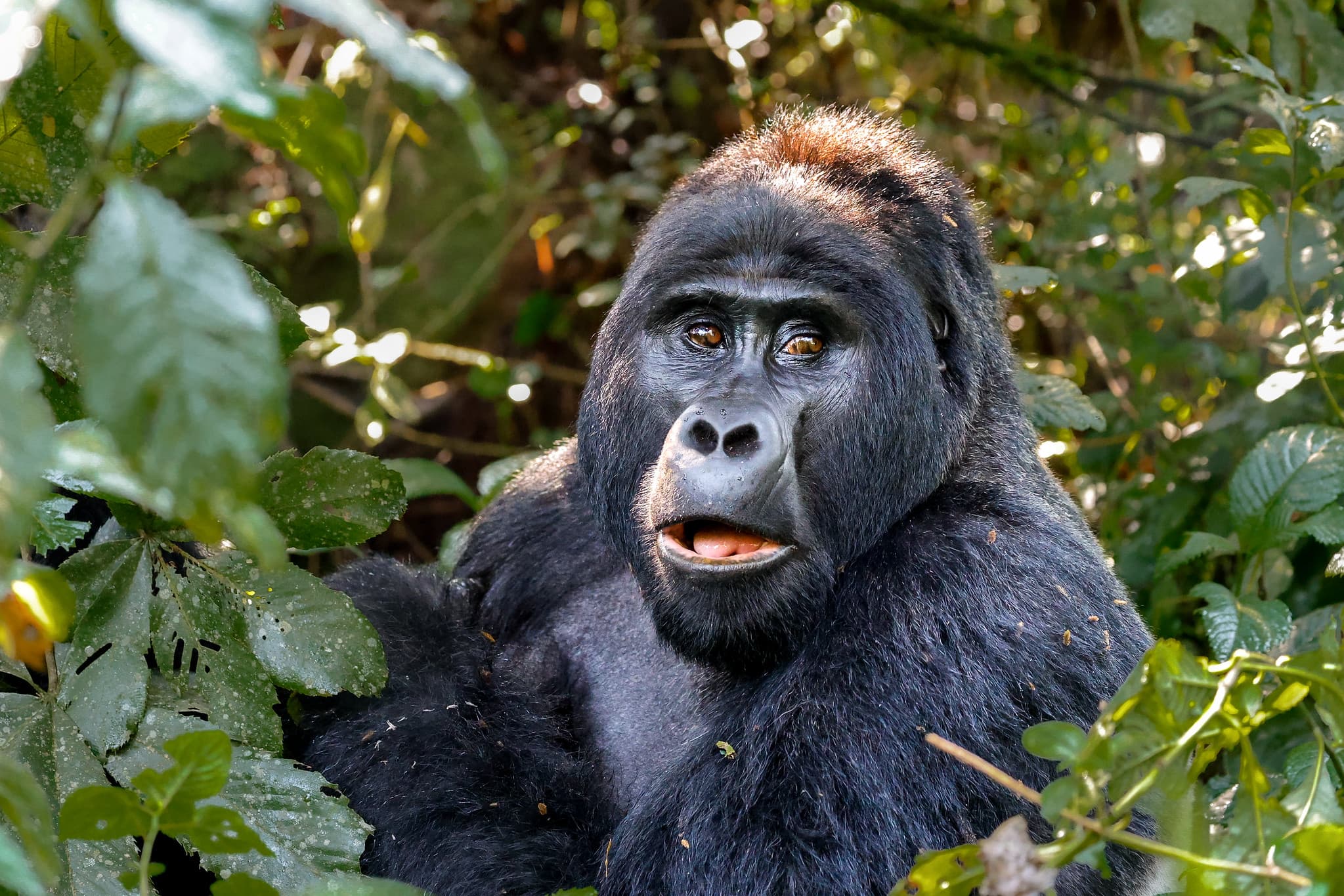
Mountain gorillas are sedentary, heavy, and largely ground-dwelling. They rest in one place for extended periods. They gaze at you with a slow, deliberate calm that gives you time to compose, adjust, and shoot. The silverback portrait — that soulful eye contact — is possible precisely because gorillas sit still long enough to let you find it.
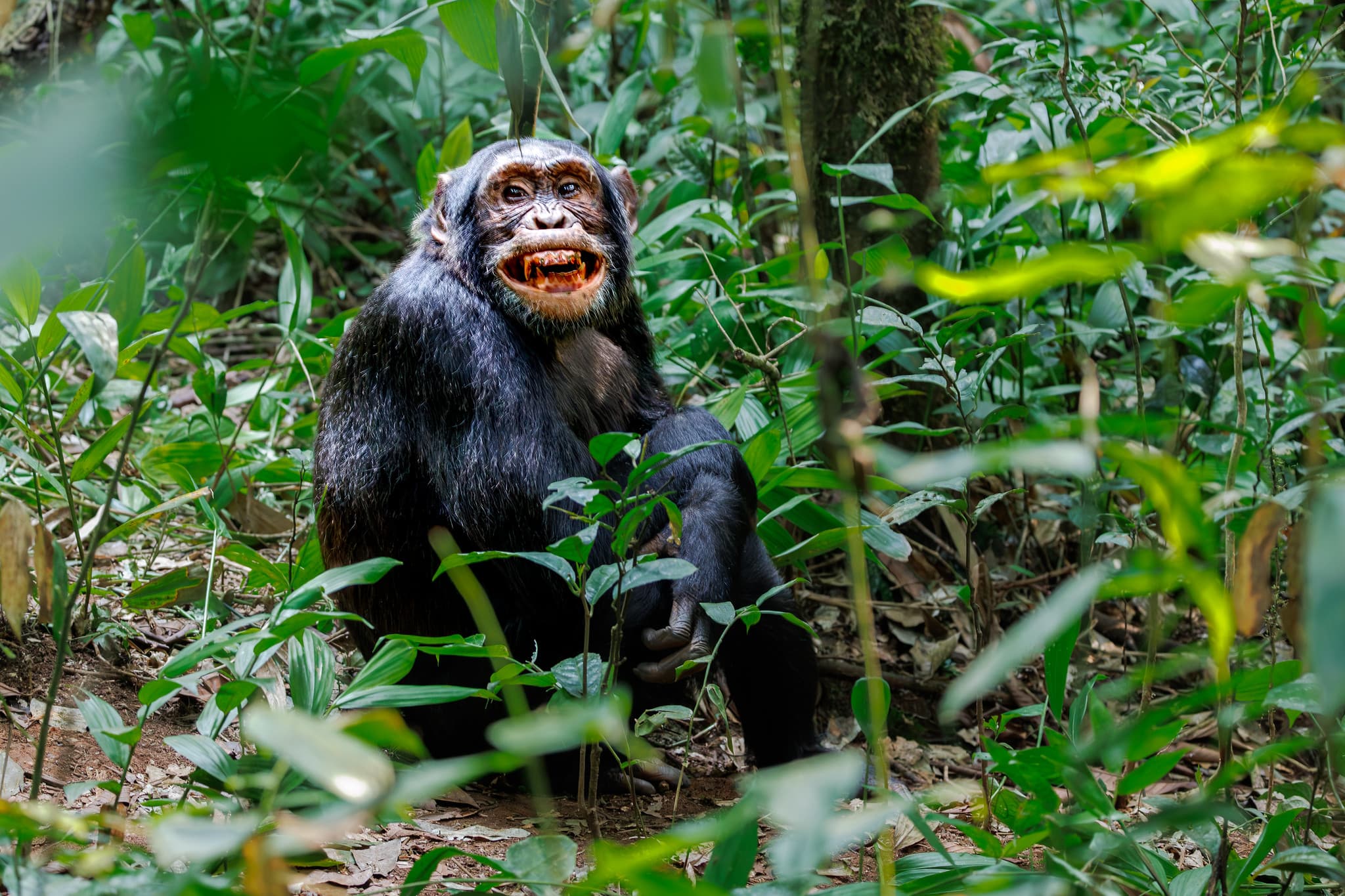
Chimpanzees do none of this. They are arboreal, fast, noisy, and genuinely unpredictable. A chimp group might be feeding quietly in the canopy one moment and exploding into a screaming dominance display the next. They swing between trees, chase each other along branches, groom for ten seconds, then bolt. Your pulse rate during a chimp trek is measurably higher than during a gorilla trek — and your keeper rate is measurably lower.
That is exactly what makes it extraordinary. Chimp photography is wildlife photography at its most raw — reactive, physical, and deeply rewarding when everything aligns.
Understanding Kibale Forest
Kibale National Park sits in western Uganda at an altitude of approximately 1,100–1,590 metres, protecting 766 square kilometres of tropical rainforest. It holds the highest density of primates of any forest on earth — 13 species, including over 1,500 chimpanzees. The forest is ancient, dense, and layered with a triple canopy that filters, scatters, and blocks light in ways that will force you to rethink everything you know about exposure.
The chimps here are habituated. Researchers and rangers have spent decades building trust with specific communities, so the chimpanzees tolerate human presence at close range. This is not a guarantee of proximity — it is a guarantee that when you are close, the chimps will behave naturally rather than fleeing. That distinction matters for photography: you are not photographing an animal reacting to you, but an animal living its life while you happen to be present.
The Trekking Experience
Chimpanzee trekking in Kibale begins at the Kanyanchu Visitor Centre, typically at 8:00 a.m. for the morning session or 2:00 p.m. for the afternoon. The morning session is generally stronger for photography — chimps are active foragers in the first hours of the day, and the forest light, while always challenging, has a softer quality before the midday sun creates harsh contrast.
Trackers head out before you do. By the time your group enters the forest, the trackers have usually located the chimp community by listening for pant-hoot vocalisations and following feeding signs. The walk to the chimps can take twenty minutes or two hours — Kibale is easier underfoot than Bwindi, with relatively flat trails through the forest, but expect mud, roots, and the occasional stream crossing.
When you reach the chimps, the standard trekking permit gives you one hour with the community. The chimpanzee habituation experience — available to a smaller number of visitors — allows you to spend up to four hours with the chimps, from the moment they descend from their night nests at dawn. If you are serious about chimp photography, the habituation experience is worth every additional dollar. The extra time transforms the experience from a rushed encounter into a genuine immersion.
What Makes Forest Canopy Light So Difficult
The light in Kibale is the single biggest challenge. On a savanna, you deal with one light source — the sun — and its direction, angle, and colour are broadly predictable. In a tropical forest, you deal with fragmented light. The canopy breaks sunlight into patches: bright pools of direct sun surrounded by deep shade. The contrast ratio between a sunlit patch on a chimp's face and the shadowed forest around it can exceed ten stops — far more than any camera sensor can capture in a single frame.
This creates two specific problems:
Blown highlights. A shaft of sunlight crossing a chimp's arm while the rest of the body is in shade will bleach to pure white. Your camera's meter, averaging the scene, will often overexpose these highlights badly.
Lost shadow detail. If you expose for the bright patches, the shadows go black. The chimp's dark face disappears into the dark forest behind it.
The practical answer is to expose for the highlights and recover shadows in post. Shoot RAW — always, without exception, in forest work. Underexpose by 1/3 to 2/3 of a stop relative to what your meter suggests. In post-processing, lift the shadows and pull down the highlights. Modern sensors have enough dynamic range to make this work, but only if you shoot RAW.
When to Embrace the Contrast
Not every dappled light scenario is a problem. Sometimes a single shaft of light falling on a chimp's face while the forest behind remains dark creates a natural spotlight effect — the subject illuminated, the background eliminated. These are some of the most striking chimp images possible. Learn to recognise when the contrast is working for you and lean into it rather than fighting it.
Camera Settings for Chimpanzee Photography
Exposure Settings
ISO: 3200–10000. The forest is dark. Accept it. Push the ISO to whatever the light demands. A sharp image at ISO 8000 is infinitely more valuable than a blurred image at ISO 800. Modern full-frame sensors — Canon R5/R6, Sony A7 IV/A1, Nikon Z8/Z9 — produce excellent results at ISO 6400 and usable results well beyond that.
Aperture: f/2.8–f/4. Maximum light gathering. The shallow depth of field is actually an advantage in the forest — it separates the chimp from the visually chaotic background of branches, leaves, and vines.
Shutter speed: 1/500s minimum; 1/800s preferred. This is the critical difference from gorilla settings. Gorillas require 1/250s minimum because they move slowly. Chimps move fast — grooming hands, turning heads, swinging through branches. At 1/250s you will get motion blur on chimp movement. Push to 1/500s as a floor, and if the light allows, go faster. For a chimp swinging between branches or in a dominance display, 1/1000s or faster is ideal.
Flash is prohibited. Same as gorilla trekking — no exceptions, no discussion.
Autofocus Settings
AF mode: Continuous (AF-C / AI Servo) with animal or face detection. Chimps' dark faces against dark backgrounds will challenge any AF system. If your camera hunts, switch to a single expandable point and manually place it on the chimp's eye.
Pre-focus constantly. When a chimp is sitting still, half-press your shutter and hold focus. Chimps go from still to explosive in a heartbeat — if you are already focused when the action begins, you will capture it.
Lens Selection
Primary: 70–200mm f/2.8
This is your workhorse in Kibale. Chimps are often at medium distance — 10 to 30 metres — and frequently in trees above you. The 70–200mm gives you the reach for canopy shots while maintaining the f/2.8 aperture you need for light and subject separation. It is also fast enough to track a moving chimp without the weight penalty of a 400mm.
Secondary: 24–70mm f/2.8
When the chimps are on the ground and close — three to eight metres — a telephoto puts you too close to focus. The 24–70mm handles close encounters and, critically, gives you the wide end for environmental portraits: a chimp framed by the towering forest, sitting on a buttress root with the green canopy soaring above.
What to Leave Behind
Your 100–400mm, 200–600mm, or any prime longer than 200mm. The forest does not offer the sight lines to use long glass effectively. You cannot back up for distance — the vegetation behind you is as dense as the vegetation in front. Long lenses also struggle with close focus distance when a chimp suddenly appears at five metres. Save the heavy glass for Queen Elizabeth or Murchison Falls.
Composition in the Canopy
Chimps spend much of their time in trees. This means you are often shooting upward at steep angles, which creates compositional challenges.
Watch for clean backgrounds. A chimp silhouetted against open sky reads beautifully — strong shape, clear subject, no clutter. A chimp against a tangle of branches at the same exposure reads as visual noise. Move your feet. A step or two to the left or right can shift the background from chaos to clarity.
Wait for behaviour. The most compelling chimp images are behavioural: grooming, feeding, a mother with an infant clinging to her belly, a juvenile play-fighting, an alpha male displaying with hair bristling. These moments pass fast, but they are frequent. Patience between bursts of action is the rhythm of chimp photography.
Eye contact is rare and powerful. Chimps make eye contact less frequently and less deliberately than gorillas. When a chimp turns and looks directly into your lens — genuinely looks at you, with those dark, intelligent, unnervingly human eyes — it is electric. Be ready for it. It will last one to three seconds.
Best Time of Day and Season
Morning treks are stronger for photography. Chimps are most active in the early hours — descending from night nests, foraging, vocalising. The light is softer, the contrast less extreme, and the chimps are on the move, which creates more opportunities for action shots and behavioural sequences.
Seasonally, the dry months — June through August and December through February — offer the most practical trekking conditions. The forest floor is drier, the trails firmer, and the canopy lets in slightly more light. Wet season treks are still productive — chimps do not stop being chimps in the rain — but the mud is significant and the forest is darker.
Habituation Experience vs Standard Trek
The standard chimpanzee trekking permit costs approximately $200 USD and gives you one hour with the chimps. The habituation experience costs approximately $250 USD and gives you up to four hours, starting at dawn.
For photographers, the habituation experience is unambiguously the better option. One hour passes brutally fast when you are adjusting to the light, repositioning around the group, and waiting for behaviour. Four hours gives you time to settle in, learn the group's rhythm, and capture the full arc of a morning — from nest departure through foraging, grooming, travel, and rest.
On fototrails 365 Uganda itineraries, I book the habituation experience whenever permits are available.
Fitting Kibale Into a Uganda Photography Itinerary
Kibale sits in western Uganda, roughly four to five hours by road from Bwindi Impenetrable Forest. The two parks combine naturally into a primate photography circuit that is unlike anything else in Africa.
A strong Uganda photography itinerary looks like this:
Entebbe — arrive, acclimatise, shoebill excursion on Lake Victoria. Kibale — two to three nights, chimpanzee habituation experience, forest birding for African grey parrots and great blue turacos. Queen Elizabeth National Park — two nights, tree-climbing lions in Ishasha, Kazinga Channel boat safari for hippos and waterbirds. Bwindi Impenetrable Forest — two to three nights, mountain gorilla trekking in Nkuringo or Rushaga sector. Murchison Falls — two nights if time allows, for the Nile boat cruise, big game, and the falls themselves.
This circuit covers the full range of Uganda's photographic diversity: primates, big cats, water mammals, forest and savanna birds, and landscapes from volcanic lakes to white-water gorges. Kibale is the energetic, fast-paced opening act. Bwindi is the profound, quiet centrepiece. Everything between and around them fills the story.
What You Will Bring Home
Gorilla photography gives you contemplative, intimate portraits — images that feel like time has stopped. Chimp photography gives you life at full speed — images that crackle with energy, chaos, intelligence, and social complexity. The two together tell a complete primate story that no single park can offer.
Kibale will test your reflexes, your ISO tolerance, and your ability to find composition in chaos. It will also give you moments of such startling connection — a chimp turning to look at you with an expression you can only describe as recognition — that the technical challenges fade to background noise. That is the image you came for. Be ready for it.
Explore This Destination