How to Photograph Leopards: Camera Settings, Techniques & Where to Find Them
Leopards are the most elusive of the big cats — and the most rewarding to photograph. Here's how to find them, set up your camera, and capture images in challenging light.
Why Leopards Are the Ultimate Challenge
In over two decades of safari photography, the leopard remains the animal I find most compelling to photograph. They are solitary, elusive, largely nocturnal, and supremely camouflaged. Unlike lions — which sleep openly on the plains — leopards live in the shadows. Finding one is an achievement. Photographing one well is an art.
But that difficulty is exactly what makes a great leopard photograph so valuable. When everything aligns — the sighting, the light, the composition — a leopard portrait is among the most powerful images you can bring home from Africa or India.
Where to Find Leopards
Africa
Masai Mara, Kenya — the Mara's riverine forests and rocky outcrops (kopjes) support a healthy leopard population. The area around the Mara River — particularly along the Talek River — offers some of East Africa's best leopard sightings. Several well-known individual leopards are habituated to vehicles, allowing close approach.
Serengeti, Tanzania — the Seronera Valley in the central Serengeti is famous for leopards. The large sausage trees along the Seronera River are classic resting spots. Leopards here are often seen dragging kills up into trees — a spectacular and very photogenic behaviour.
South Luangwa, Zambia — arguably the best place on the continent for leopard photography, especially during the dry season (June–October) when they are concentrated along the Luangwa River.
India
Kabini, Karnataka — the backwaters of Kabini are home to one of India's densest leopard populations. The open terrain around the reservoir makes sightings more reliable than in most Indian forests.
Bandipur, Karnataka — leopards share territory with tigers here. Sightings are less frequent than in Kabini but the forest setting produces beautiful images with dappled light filtering through the canopy.
Camera Settings for Leopard Photography
Leopards present two distinct challenges: they are often in low light (forest shade, dawn, dusk, overcast) and they move unpredictably — a resting leopard can launch into a sprint with zero warning.
Resting or Stationary Leopard
- Aperture: f/4 – f/5.6 for shallow depth of field and subject isolation. Leopard portraits benefit enormously from a blurred background that makes the rosettes pop.
- Shutter speed: 1/250s minimum. Even a resting leopard shifts its head constantly — scanning, yawning, blinking. A slow shutter will cost you sharpness.
- ISO: Push it. ISO 1600–6400 is normal and necessary. Modern cameras handle high ISO beautifully. A sharp image at ISO 3200 is infinitely better than a blurry image at ISO 400.
- Focus mode: Single-point AF on the eye. Always the eye.
Walking or Stalking Leopard
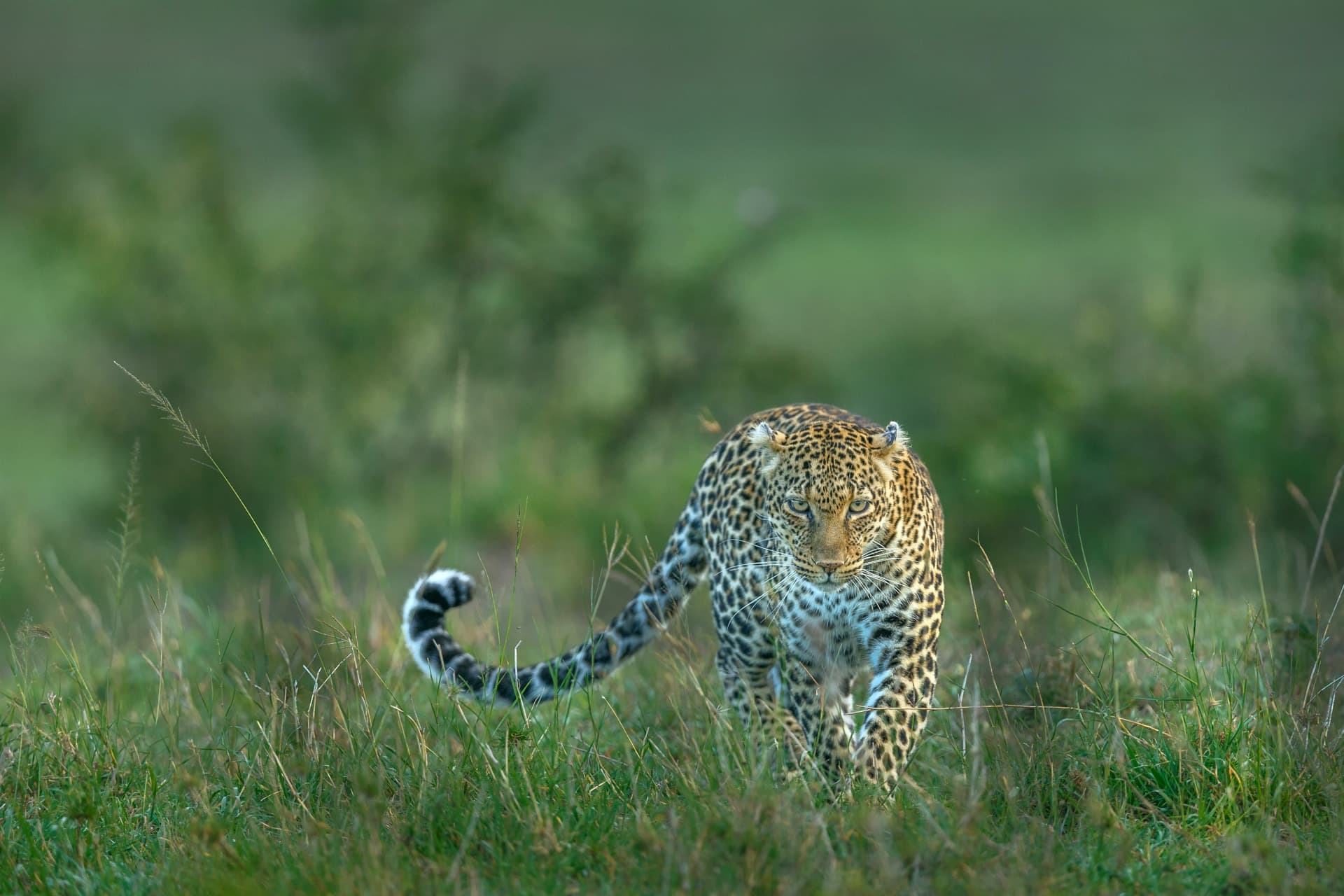
- Shutter speed: 1/800s minimum, 1/1000s preferred. When a leopard walks, its body undulates — you need speed to freeze the motion.
- Focus mode: Continuous AF (AI Servo / AF-C) with animal-eye tracking if your camera supports it. Keep the focus point locked on the face.
- Drive mode: High-speed burst. The difference between a leopard with eyes open versus closed is one frame.
Leopard in a Tree
This is one of safari photography's iconic compositions — but it is technically demanding. The leopard is often backlit or in dappled shade with bright sky behind.
- Exposure compensation: +0.7 to +1.3 EV to avoid underexposing the cat against a bright sky.
- Spot metering on the leopard's body rather than evaluative metering, which will be fooled by the bright background.
- Watch your angle — try to position so the leopard's body is framed against foliage rather than open sky. This gives a cleaner background and more even exposure.
Technique: Patience Above All
The single most important leopard photography technique is patience. When you find a resting leopard, resist the urge to fire hundreds of frames immediately. Wait.
Leopards cycle through behaviours — sleeping, yawning, stretching, scanning, grooming. The best images come 20–40 minutes into a sighting, when the animal has become comfortable with your presence and begins to behave naturally. A yawn showing the full canines. A stretch that shows the power of the shoulders. Eye contact through the grass.
I tell my guests: take your establishing shots in the first minute, then put the camera down and watch. When the leopard does something, you will be ready. If you have been firing continuously, your reactions will be dulled and your card will be full of identical sleeping poses.
Composition Tips
Fill the Frame — But Not Too Much
A tight portrait showing just the face and shoulders works beautifully for leopards because the rosette pattern is mesmerising at close range. But also pull back for environmental shots that show the leopard in context — walking through tall grass, draped over a tree branch, silhouetted at dusk.
The Eyes Tell the Story
A leopard photograph without sharp eyes is a failed photograph. Everything else can be slightly soft — but the eyes must be tack-sharp and ideally catching light. A tiny catchlight in the eye transforms a good portrait into a remarkable one.
Vertical Compositions
Many photographers default to horizontal framing, but leopards in trees are often better as vertical compositions. The tree trunk leads the eye upward to the cat. Try both orientations — you can decide later.
Ethical Distance
Leopards tolerate vehicles at surprisingly close range, especially in areas where they are habituated. But tolerance is not comfort. Watch the leopard's body language:
- Ears pinned back = stressed. Back away.
- Tail flicking rapidly = agitated. Give space.
- Looking directly at the vehicle repeatedly = uncomfortable. Reduce engine noise and movement.
On my tours, we follow a simple rule: let the leopard set the distance. If it walks toward us, wonderful. We never pursue, never block a path, never use engine noise to get a reaction. The best sightings come from patience and respect, not aggression.
From Sighting to Portfolio Image
A single good leopard sighting can give you a portfolio-quality image. But it requires the right preparation — high ISO settings ready, continuous AF engaged, beanbag positioned — and then the discipline to wait for the moment rather than chasing it.
Some of my favourite leopard images were taken 45 minutes into a sighting, when the animal finally lifted its head into a patch of golden light. Those 45 minutes of waiting are the price. The image is the reward.