Photographing the Serengeti Calving Season: When, Where & How to Capture New Life
Every January to March, 8,000 wildebeest calves are born per day on the Serengeti's short-grass plains. Here's how to photograph one of nature's most dramatic spectacles.
What Is the Calving Season?
The Serengeti calving season is one of the most extraordinary natural events on earth, and one of the least photographed compared to the famous Mara River crossings. Between January and March each year, the great wildebeest herds concentrate on the short-grass plains of the southern Serengeti and the Ndutu area near the Ngorongoro Conservation Area boundary.
Here, on vast, open plains with virtually no trees or obstruction, roughly 500,000 wildebeest calves are born in a window of just a few weeks — roughly 8,000 per day at the peak. The timing is synchronised as a survival strategy: predators cannot possibly eat them all.
Why Photographers Should Prioritise Calving Season
Most safari photographers focus on the Mara River crossings (July–October), and for good reason — they are spectacular. But the calving season offers something the crossings do not:
Intimacy. The interactions between mothers and newborn calves — a calf standing on trembling legs for the first time, a mother nudging her baby to walk, twins keeping close — are deeply emotional and visually compelling.
Predator action. The abundance of vulnerable young animals draws every predator in the ecosystem. Cheetahs, lions, hyenas, and jackals are all hunting actively. The open plains mean sightings are unobstructed and dramatic. A cheetah chase across flat terrain is one of the most photogenic events in wildlife.
Open terrain. The southern Serengeti's short-grass plains offer 360-degree sight lines. No trees, no obstructions. This means clean backgrounds, dramatic skies, and the ability to see predator-prey interactions unfold from a distance.
Fewer crowds. Calving season draws a fraction of the visitors that the river crossings attract. You will often have sightings to yourself.
Where Exactly to Be
Ndutu Area
The Ndutu area sits on the boundary between the Serengeti National Park and the Ngorongoro Conservation Area. This is the epicentre of the calving. The short-grass plains here are fed by the alkaline soils of the volcanic highlands, producing nutrient-rich grazing that the wildebeest seek out year after year.
Stay at one of the camps or lodges near Lake Ndutu or Lake Masek. These give you direct access to the calving grounds without long drives.
Southern Serengeti Plains
The plains stretching south from Seronera toward Ndutu — including the areas around Naabi Hill Gate and the Gol Kopjes — also hold large concentrations of wildebeest during calving season. The kopjes (granite rock outcrops) are often where lions wait in ambush.
Camera Settings for Calving Season
Calving Scenes and Newborn Portraits
- Focal length: 200–400mm. The animals are in vast herds and you want to isolate individual mothers and calves from the mass.
- Aperture: f/5.6 – f/8. Wide enough for a soft background but sharp across the subject.
- Shutter speed: 1/500s for standing calves, 1/1000s+ for calves attempting to walk or run (they stumble frequently — those moments are gold).
- ISO: 200–800 during the day. The plains are brightly lit.
Predator-Prey Action
- Shutter speed: 1/2000s minimum. Cheetah chases happen at 100 km/h. Lions explode from a crouch without warning.
- Focus mode: Continuous AF with animal tracking. Keep the focus point on the predator, not the prey — the predator is what tells the story.
- Drive mode: Maximum burst rate. In a 10-second chase sequence, the difference between a publishable image and a near-miss is measured in milliseconds.
- Pre-focus: When you see a predator watching the herd, pre-focus on it and wait. Do not take your eye from the viewfinder. The launch happens in less than a second.
Herd-Scale Landscapes
Do not only shoot telephoto. The calving herds stretched across the open plains under towering cumulus clouds is one of the greatest landscape subjects in Africa.
- Wide angle: 24–70mm or even 16–35mm for epic scale.
- Small aperture: f/11 – f/16 for maximum depth of field.
- Include foreground interest — a single wildebeest, a skull, a termite mound — to anchor the composition.
The Light
January to March in the southern Serengeti offers phenomenal light. The green season means dramatic skies — towering thunderheads, scattered rain showers catching sunlight, and spectacular sunsets over the endless plains.
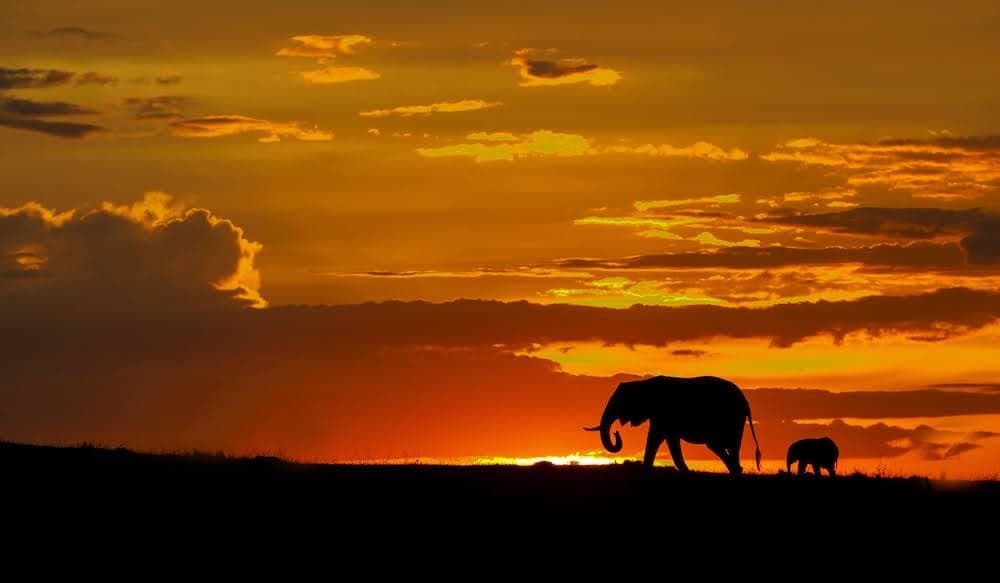
Golden hour is everything. The first and last hour of daylight turns the short grass amber and catches dust particles in the air. Backlighting a herd at sunrise — where the animals become silhouettes against a warm sky — is one of the most iconic images you can create here.
Midday light is harsh but can work for overhead raptor shots and high-contrast black-and-white compositions.
What Makes Calving Season Special for Photography
The river crossings are about chaos and adrenaline — animals leaping, crocodiles striking, water spraying. The calving season is about tenderness and vulnerability — a mother cleaning her newborn, a calf's first steps, the quiet drama of survival.
Both are extraordinary. But if you have only photographed the crossings, you are missing half the story of the Great Migration. The calving grounds are where it all begins.
On our Serengeti tours, I always recommend including at least 3 nights in the Ndutu area during calving season. The concentration of life — and the quality of light on those open plains — creates photography opportunities that are difficult to find anywhere else on earth.
Explore This Destination