Mirrorless vs DSLR for Safari Photography in 2026: The Honest Field Guide
Both systems work on safari. But the practical differences — autofocus, battery life, weight, dust sealing — matter more than spec sheets. Here's how to decide, from years of guiding photographers with both.
The Question Every Safari Guest Asks
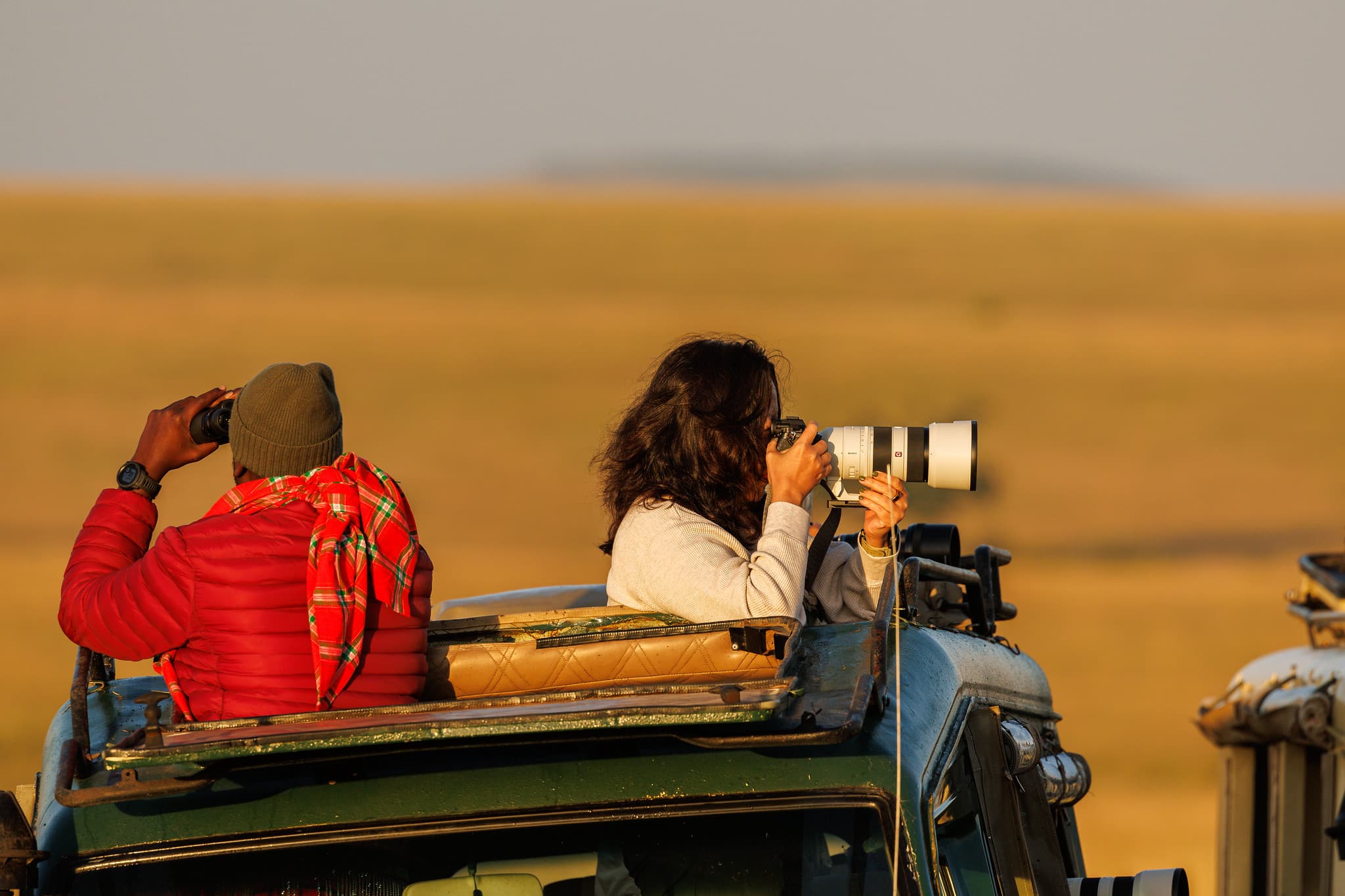
On nearly every fototrails 365 tour, someone asks: should I switch to mirrorless before this trip? Or: is my DSLR still good enough?
The short answer is that both work. The longer answer — the one that actually helps you make a decision — requires looking at the specific conditions of an African safari: long bumpy drives, extreme dust, harsh midday sun, unpredictable bursts of action, and subjects that move from sleeping in shade to sprinting across open grassland in seconds.
This is not a lab comparison. It is a field guide based on years of watching photographers use both systems on safari in the Masai Mara, Serengeti, Amboseli, and beyond.
Autofocus: Mirrorless Has Caught Up — and Then Some
Three years ago, DSLR autofocus still had a meaningful edge for erratic, fast-moving subjects. That is no longer true. The latest mirrorless bodies from Sony, Canon, and Nikon now match or exceed DSLR AF performance for wildlife tracking.
What Changed
Modern mirrorless cameras use AI-driven subject recognition — animal eye detection, bird detection, even species-level identification on some bodies. This means the camera can acquire and lock onto the eye of a cheetah running at full speed through tall grass with a reliability that phase-detect DSLR systems cannot replicate. The sensor-based AF covers virtually the entire frame, not just a cluster of points in the centre.
On a DSLR like the Canon 1DX III or Nikon D6, the AF system is still excellent — fast, decisive, and battle-tested. But the AF points are concentrated in the central portion of the frame. If you compose with the subject off-centre, you are either focus-and-recomposing (which introduces error at wide apertures) or relying on fewer, less capable outer points.
What This Means on Safari
For a cheetah hunt, a river crossing, or a bird lifting off a branch, mirrorless AF tracking is now the easier tool to use. You point the camera, the AI finds the animal's eye, and the system holds focus through movement, obstructions, and depth changes. DSLRs can achieve the same results, but they demand more skill and more AF point management from the photographer.
If you are an experienced DSLR shooter who knows your AF system inside out, you will not suddenly fail on safari. But if you are choosing a new system today, mirrorless AF is the stronger starting point.
Battery Life: DSLR Still Wins, but It Barely Matters
A DSLR optical viewfinder uses no power. A mirrorless electronic viewfinder (EVF) runs constantly when the camera is active. The result: a DSLR body typically delivers 1,500–3,000 shots per charge; a mirrorless body delivers 400–800, depending on EVF usage, review habits, and temperature.
On paper, that is a significant difference. In practice, it is easily solved.
The Safari Reality
A single spare battery eliminates the issue. Two spares make it irrelevant. On a typical safari day — morning drive, midday break, afternoon drive — even heavy shooters rarely exceed 1,500 frames. With two charged batteries, any modern mirrorless body will last comfortably through the day.
Every fototrails 365 vehicle has charging points. Between drives, you charge. The battery gap between mirrorless and DSLR is real but costs less than the price of two spare batteries to close.
If you are moving to mirrorless, buy three batteries. Problem solved.
Electronic Viewfinder vs Optical Viewfinder
This is the most subjective difference between the two systems, and it matters more on safari than in any other shooting environment.
Where EVF Wins: Low Light and Exposure Preview
An electronic viewfinder shows you the actual exposure before you press the shutter. In the dim light of an early morning drive — a leopard in a tree at 6:15am, a hyena den in shadow — the EVF brightens the scene and shows you exactly what the sensor will capture. An optical viewfinder shows you the dim scene as your eye sees it. You are guessing at exposure until you review the LCD.
This is a genuine advantage. On dawn and dusk drives, EVF users spend less time chimping (checking the LCD after every shot) and more time shooting.
Where OVF Wins: Harsh Midday Sun
Under the intense equatorial sun of East Africa, EVF screens can be harder to see clearly, even at maximum brightness. An optical viewfinder is unaffected by ambient light — you look through a prism and see the world directly. On a bright midday drive (which you will occasionally do, despite the less favourable light), the OVF is more comfortable.
Where EVF Wins Again: Focus Peaking and Magnification
For manual focus lenses — which some photographers bring for creative work — the EVF's focus peaking overlay and punch-in magnification make precise focusing far easier than an optical viewfinder ever could.
The Verdict on Viewfinders
If most of your critical shots happen at dawn and dusk (as they should on a well-planned safari), the EVF is the more useful tool. If you spend long hours scanning the landscape in bright conditions, the OVF is more comfortable. Most photographers adapt to EVF within a day or two and do not look back.
Weight and Size: Mirrorless Wins on Long Drives
A safari day involves 4–6 hours in a vehicle, often on rough roads. Every kilogram matters — not for carrying, but for fatigue. Holding a heavy camera-lens combination steady on a beanbag over a window frame, hour after hour, is physically demanding.
Mirrorless bodies are typically 100–300g lighter than equivalent DSLRs. The lenses are where the real savings appear: the Sony 200–600mm f/5.6–6.3 weighs 2,115g; a comparable DSLR-era lens like the Nikon 200–500mm f/5.6 weighs 2,300g. Canon's RF 200–800mm, while heavier than both, has no DSLR equivalent at all.
These differences compound over a 10-day safari. Lighter gear means less arm fatigue, steadier shots in the final hour of a long afternoon drive, and more willingness to keep the camera up and ready when that split-second moment arrives.
Dust Sealing: Both Can Handle It, but Be Careful
East African environments are dusty. The Mara in dry season, Amboseli near Kilimanjaro, the Serengeti's volcanic soil — fine particulate gets everywhere.
Both DSLR and mirrorless bodies at the professional and semi-professional tier are well-sealed against dust and moisture. The concern with mirrorless is the exposed sensor during lens changes — without a mirror box between the lens mount and the sensor, dust can settle directly on the imaging surface.
Practical Advice
- Minimise lens changes in the field. Bring two bodies with different lenses mounted if possible.
- When changing lenses, point the camera body downward and shield it from wind.
- Carry a rocket blower in your camera bag.
- Professional-grade mirrorless bodies (Sony A1, Canon R5 II, Nikon Z8) have sensor-shift dust removal that works well for fine particles.
In years of guiding photographers with mirrorless cameras, sensor dust has been an occasional nuisance, never a trip-ruining problem. But it does require slightly more awareness than a DSLR.
Buffer Depth and Burst Shooting
Safari photography demands burst shooting — a cheetah hunt lasts seconds, a river crossing is chaos, and a bird in flight gives you fractions of a second to compose.
Modern mirrorless cameras offer extraordinary burst rates: 20 fps on the Sony A1, 30 fps on the Canon R5 II with electronic shutter, 20 fps on the Nikon Z8. DSLRs top out around 14–16 fps on the Canon 1DX III and 14 fps on the Nikon D6.
Buffer depth — how many frames the camera can sustain before it slows down — depends on the card type. Most current mirrorless bodies use CFexpress cards, which offer deep buffers (often 100+ RAW frames at full burst). Older DSLR bodies using CF or SD cards may have shallower buffers.
For safari shooting, 10–12 fps is more than sufficient. Both systems deliver this. The higher burst rates of mirrorless are a luxury, not a necessity — but they do increase your chances of capturing the exact peak moment.
Lens Availability and Adaptation
Native Mirrorless Lenses
All three major manufacturers now have comprehensive native mirrorless lens lineups. The key safari lenses are well covered:
- Sony: 200–600mm f/5.6–6.3, 100–400mm f/4.5–5.6 GM, 600mm f/4 GM
- Canon RF: 100–500mm f/4.5–7.1 L, 200–800mm f/6.3–9, 600mm f/4 L
- Nikon Z: 100–400mm f/4.5–5.6 S, 180–600mm f/5.6–6.3, 600mm f/4 S
DSLR Lens Adaptation
If you own DSLR lenses and are considering a mirrorless body, the good news is that Canon EF lenses adapt perfectly to RF bodies (with Canon's own adapter), and Nikon F lenses adapt well to Z bodies (with the FTZ II adapter). Sony A-mount lenses adapt to E-mount with the LA-EA5.
This means you do not need to replace your entire lens collection when switching systems. Start with a mirrorless body and your existing glass; upgrade lenses later as budget allows.
Camera Recommendations by Budget
Under $2,000 (Body Only)
- Canon R7 (APS-C, 32.5MP, 15 fps) — excellent value for wildlife, crop factor extends your reach
- Nikon Z6 III (full-frame, 24.5MP, 14 fps) — superb AF, great low-light performance
- DSLR alternative: Canon 90D or Nikon D500 (both discontinued but available used at excellent prices)
$2,500–$4,000
- Sony A7R V (full-frame, 61MP, 10 fps) — extraordinary resolution, AI-based AF, superb dynamic range
- Canon R6 III (full-frame, 24.2MP, 40 fps electronic) — fast, versatile, excellent in low light
- Nikon Z8 (full-frame, 45.7MP, 20 fps) — essentially a Z9 in a smaller body, outstanding all-rounder
$4,000+
- Sony A1 (full-frame, 50.1MP, 30 fps) — the do-everything flagship, no compromises
- Canon R5 II (full-frame, 45MP, 30 fps electronic) — Canon's best wildlife body, stunning AF
- DSLR alternative: Canon 1DX III or Nikon D6 — still superb if bought used; bulletproof reliability, but no longer manufactured
Nitin's Take
Most guests on fototrails 365 tours now arrive with mirrorless bodies. The transition has been clear and steady over the past three years. But some of the finest images captured on our tours have come from photographers using a Nikon D850, a Canon 5D IV, or even a well-handled Canon 7D II. The camera body matters far less than the lens in front of it, the light around you, and the patience to wait for the right moment.
How to Decide: The Practical Framework
If you already own a DSLR system with good lenses, ask yourself:
1. Is your AF frustrating you? If you are missing shots because of AF limitations, mirrorless will help.
2. Is the weight wearing you down? If you dread holding the camera up after three hours in the vehicle, lighter mirrorless gear will improve your shooting endurance.
3. Are you buying new lenses anyway? If so, invest in the mirrorless ecosystem — that is where all future development is going.
4. Is your current system working? If yes, bring it. Spend the upgrade budget on a better lens or a longer safari.
If you are buying your first serious wildlife system from scratch, buy mirrorless. The technology advantages are real, the lens ecosystems are mature, and all future innovation is on this platform.
The Honest Answer
Both mirrorless and DSLR cameras produce stunning safari images. The differences are real but manageable. Autofocus tracking favours mirrorless. Battery life favours DSLR. Weight favours mirrorless. Viewfinder preference is personal. Dust management requires slightly more care with mirrorless. Burst rate and buffer favour mirrorless at the high end.
No photographer has ever returned from safari saying the trip was ruined by their choice of mirror or no mirror. The light, the wildlife, the guide, the patience — these determine your images. The camera body is the least important variable in the equation.
Bring what you have. Learn it deeply. And spend your energy on being ready when the moment arrives.