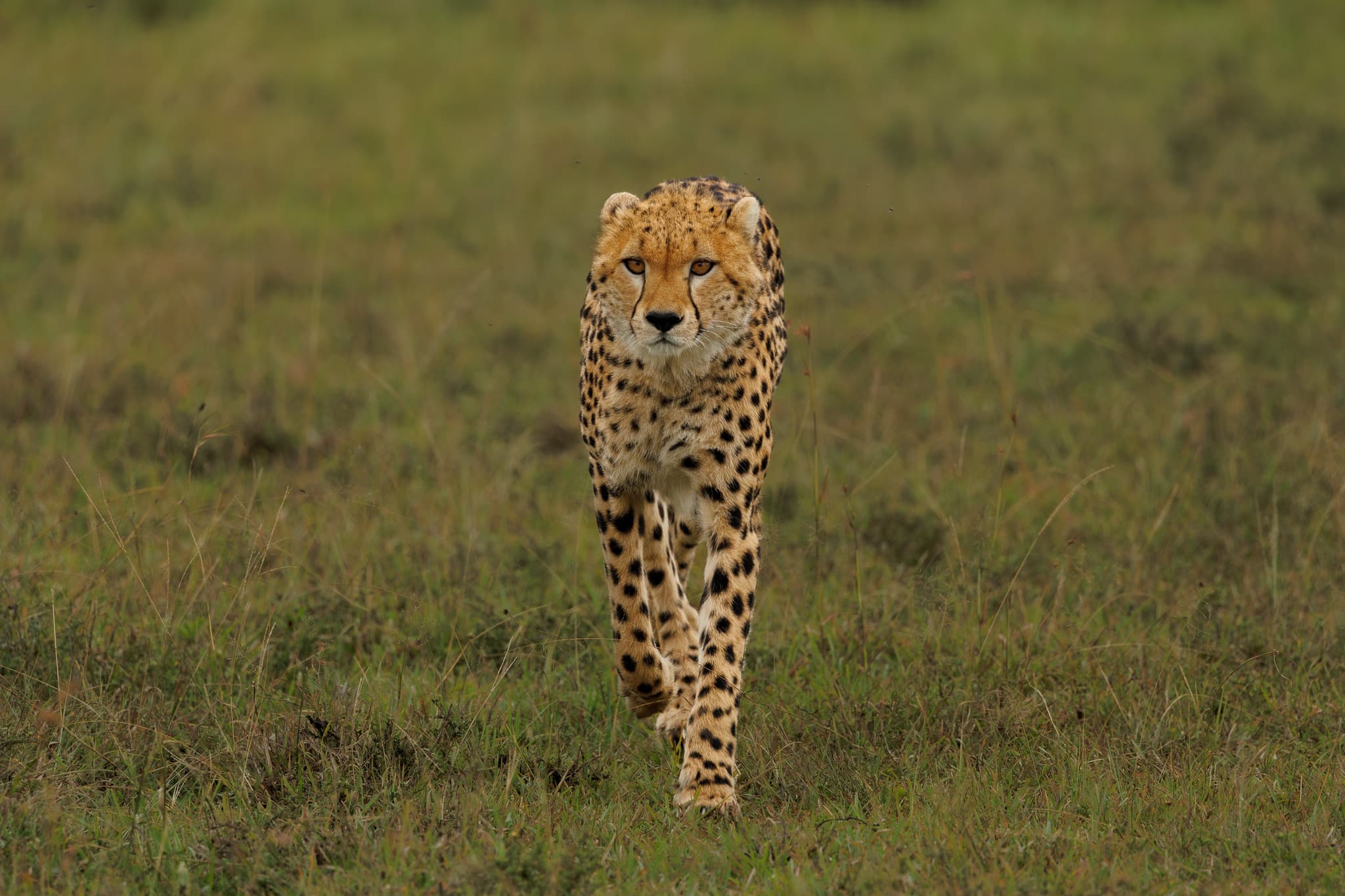
Ngorongoro Crater Wildlife Photography Guide: Shooting Inside the Caldera
The world's largest intact caldera concentrates the Big Five into 260 square kilometres of grassland, lake, and forest. Here's how to photograph it — from the descent to the crater floor to the flamingos at Lake Magadi.
The Crater Is Not Like Anywhere Else
Most wildlife photography destinations in East Africa are open systems — animals move freely across vast landscapes, and finding them means covering ground. The Ngorongoro Crater is fundamentally different. It is a closed ecosystem. Roughly 25,000 large mammals live permanently on a 260 square kilometre caldera floor, surrounded on all sides by walls rising 600 metres. The animals do not leave. The density is extraordinary. On a good day, you can photograph all five members of the Big Five without driving more than 30 kilometres.
This concentration is what makes Ngorongoro one of the most productive single-day wildlife photography locations in Africa. But the crater's unique geography also creates unique photographic challenges — light behaves differently inside a caldera, the terrain limits positioning, and vehicle regulations impose time constraints that demand planning and efficiency.
This guide covers what I have learned across many descents into the crater, and how to make the most of every hour on the floor.
The Descent: Your First Photographic Opportunity
The crater has two access roads — one down, one up — and both are steep, narrow, and winding through dense montane forest on the crater wall. The descent takes approximately 25 to 30 minutes. Most photographers treat this as transit time. That is a mistake.
The descent road passes through thick forest that occasionally opens into clearance points with sweeping views across the entire caldera floor. On clear mornings, you can see the full 20-kilometre diameter of the crater laid out below — Lake Magadi shimmering in the centre, green grasslands stretching to the far wall, and often a low band of mist sitting just above the floor. This is a landscape image worth stopping for.
Timing the descent is critical. I aim to reach the crater rim gate at first light — around 6:15 to 6:30am depending on the season. This puts you on the crater floor by approximately 7:00am, when the early golden light is still low and directional but strong enough to illuminate subjects. The mist that settles on the caldera floor overnight often lingers until 7:30 or 8:00am, creating an atmospheric, almost ethereal quality to early morning images that is unique to the crater.
If you descend later — after 8:00am — you lose the mist entirely, the light is already climbing, and you have burned an hour of the best shooting conditions.
Understanding the Crater's Light
The single most important thing to understand about photographing inside the Ngorongoro Crater is that light behaves differently here than on the open plains.
The 600-metre crater walls act as a natural bowl that affects light in three ways:
Morning shadow. The eastern wall casts a long shadow across the western portion of the crater floor in the early morning. This means subjects on the western side may still be in cool shadow while the eastern grasslands are already lit with warm, golden light. Plan your first hour on the eastern and central sections of the floor.
Reflected light. The green forested walls reflect a subtle fill light back onto the crater floor, particularly in the wet season when the vegetation is lush. This natural fill reduces harsh contrast on animal subjects in a way you simply do not get on the open Serengeti. Shadows are softer. Detail in dark fur — buffalo, wildebeest — is more recoverable.
Cloud and weather dynamics. The crater creates its own microclimate. Clouds frequently build along the rim by mid-morning and can spill over the edge, creating dramatic backdrops of mist and cloud against the green wall. These conditions — animals in golden grass with a wall of mist behind them — are uniquely Ngorongoro. Watch for them and shoot immediately; they shift within minutes.
Camera Settings for Crater Light
The reflected fill light and often slightly hazy early conditions inside the crater call for some adjustment from standard open-plains settings:
Early morning (mist and golden light):
- Shutter speed: 1/800s minimum for stationary subjects; 1/1600s for movement
- Aperture: f/5.6–f/7.1 — the softer light allows stopping down slightly without losing shutter speed
- ISO: Auto, capped at 3200 (the light is gentler but not dim)
- White balance: Daylight or Auto — the mist can trick Auto WB into overcorrecting. Shoot RAW and adjust in post
- Exposure compensation: +0.3 to +0.7 if shooting a dark subject (buffalo, rhino) against bright grass; the meter will overexpose the grass and underexpose the animal
Midday (flat overhead light):
- Drop to f/8 for depth of field across environmental scenes
- Use the flat light for documentary-style compositions — wide shots showing animals against the crater wall
- ISO 200–400 is achievable; use the low ISO for maximum detail in landscape-oriented frames
- Consider a polarising filter to cut haze and deepen the green of the crater walls
Late afternoon (golden light returns from the west):
- Return to fast settings: 1/1000s, f/5.6, Auto ISO
- The western light illuminates the eastern crater wall behind your subjects — use this backlit wall as a dramatic warm backdrop
- Expose for the subject, not the background; let the golden wall go slightly bright
Key Species and Where to Find Them
Lions — The Crater's Signature Subject
Ngorongoro has one of the highest lion densities in Africa. The population is relatively small — roughly 60 to 70 individuals — but confined to the crater floor, which means encounters are frequent and often close. The lions here are remarkably habituated to vehicles, allowing intimate portraits and behavioural sequences.
The best areas for lion sightings are the open grasslands in the central and southern sections of the crater, particularly around the Lerai Forest edge and the marshland borders. Lions often rest in the short grass near the lake margin in the morning, moving to shade near the fever tree forest by midday.
Black Rhino — Rare and Rewarding
Ngorongoro is one of the most reliable locations in Tanzania for black rhino photography. The crater supports a small but consistent population that is sighted on most days. They tend to favour the open grassland areas on the western and southwestern floor.
Be realistic about the images — rhino sightings in the crater are often at moderate distance (100 to 200 metres), so a 500mm or 600mm lens is valuable here. The animals are not as habituated as the lions, and approaching too close will cause them to move off. Patience and a long lens produce better results than trying to close the distance.
Flamingos at Lake Magadi
The shallow, alkaline Lake Magadi and the adjacent freshwater pools on the crater floor attract lesser flamingos in extraordinary numbers. At peak concentration, the lake margin turns pink — thousands of birds feeding, preening, and lifting off in coordinated flight.
Positioning tip: Approach the lake from the north or northeast in the morning, placing the sun behind you and illuminating the flamingos against the blue water. The classic composition is a wide shot showing the pink line of flamingos stretching along the lake edge with the green crater wall rising behind — a layered image of colour and scale that is uniquely Ngorongoro.
For flamingos in flight, pre-focus on the flock and wait. When one group lifts off, others follow in a chain reaction. Use continuous AF at 1/2000s minimum to freeze wingbeats. A 200–400mm range works well — too tight and you lose the sense of mass; too wide and the birds become pink specks.
Elephants, Buffalo, and Hippo
Large bull elephants are common on the crater floor, often solitary and moving slowly through the grassland. They photograph beautifully against the crater wall backdrop. Buffalo herds are large and ever-present — useful for dramatic herd-scale compositions and predator-prey context when lions are nearby.
Hippos are concentrated in the Gorigor Swamp and the freshwater pools near Lake Magadi. The combination of hippos in the foreground with flamingos in the background is a distinctive Ngorongoro composition worth seeking out.
How Ngorongoro Differs from the Serengeti
Photographers often combine Ngorongoro and the Serengeti on a single Tanzania circuit, and understanding the differences helps you adjust your approach for each.
Scale vs concentration. The Serengeti is vast and requires covering distance to find subjects. Ngorongoro is compact and rewards slow, methodical working of a small area. Resist the urge to rush between sightings — spend time with each subject.
Light quality. The Serengeti's open plains produce classic, unobstructed light with hard shadows and clean backgrounds. The crater's enclosed geography produces softer, more complex light with the green wall as an ever-present backdrop. Neither is better; they are different palettes.
Backgrounds. In the Serengeti, your background is typically sky or distant plain. In the crater, the forested wall is almost always in frame. This can be a strength — the layered green behind a golden-lit lion is dramatic — or a challenge if the wall is in harsh light while your subject is in shadow. Position the vehicle to manage the background as carefully as you manage the foreground.
Time pressure. The Ngorongoro Conservation Area Authority limits crater visits to approximately six hours per descent. You enter in the morning and must ascend by early afternoon. There is no option to stay for sunset on the crater floor. This makes planning and efficiency essential — know what you want to photograph, know where to find it, and use your time deliberately.
Nitin's Positioning Tips for the Crater
Over many visits, I have developed a circuit that maximises the crater's photographic potential within the six-hour window:
First hour (7:00–8:00am): Head east and south toward the open grasslands. This is where the first light hits and where lions are most active. The mist is still lifting and creates beautiful atmospheric depth behind subjects.
Second and third hours (8:00–10:00am): Move toward Lake Magadi for flamingo photography. The mid-morning light is still workable and the birds are active. Scan the open ground on the western side for rhino.
Late morning (10:00am–12:00pm): Work the Lerai Forest edge for elephants and woodland birds. The flat midday light is less punishing here because the forest canopy provides natural diffusion. This is also when hippo pools are worth visiting — the overhead light penetrates the water and shows detail.
Final hour: Use the remaining time for any subjects you missed or want to revisit. The light is building toward afternoon warmth but you will need to begin the ascent before the best golden hour returns.
What to Bring
Lenses: A 100–400mm or 150–600mm zoom covers 80% of crater photography. A 70–200mm f/2.8 is valuable for close lion encounters in the softer morning light. A wide-angle lens (16–35mm) is essential for the descent viewpoints and caldera-scale landscape shots.
Protection: The crater rim is at 2,300 metres and can be cold — mist and cloud at dawn mean temperatures of 8–12°C at the start of the descent. Bring a fleece layer. The crater floor warms quickly once the sun clears the eastern wall.
Memory and batteries: Six hours of concentrated shooting in a target-rich environment means high frame counts. Bring more cards than you think you need. The crater is not the place to run out of storage.
The Image That Stays
Every location has one image that defines it in a photographer's memory. For the Serengeti, it is the herd stretching to the horizon. For Amboseli, it is the elephant against Kilimanjaro. For Ngorongoro, it is the moment you look across the crater floor in the first golden light — mist still clinging to the grassland, the lake glinting in the distance, a lion walking slowly through the dew — and realise that everything you want to photograph is contained within the walls of this ancient caldera. The crater gives you Africa in a single frame. Your job is to be ready for it.
Explore This Destination